Current projects.
The work I’m building now: devices that respond to place, local AI, films from photographs and conversations, and public data made useful.
Niwaban
From my 2012 mobile app to managed phones and watches.
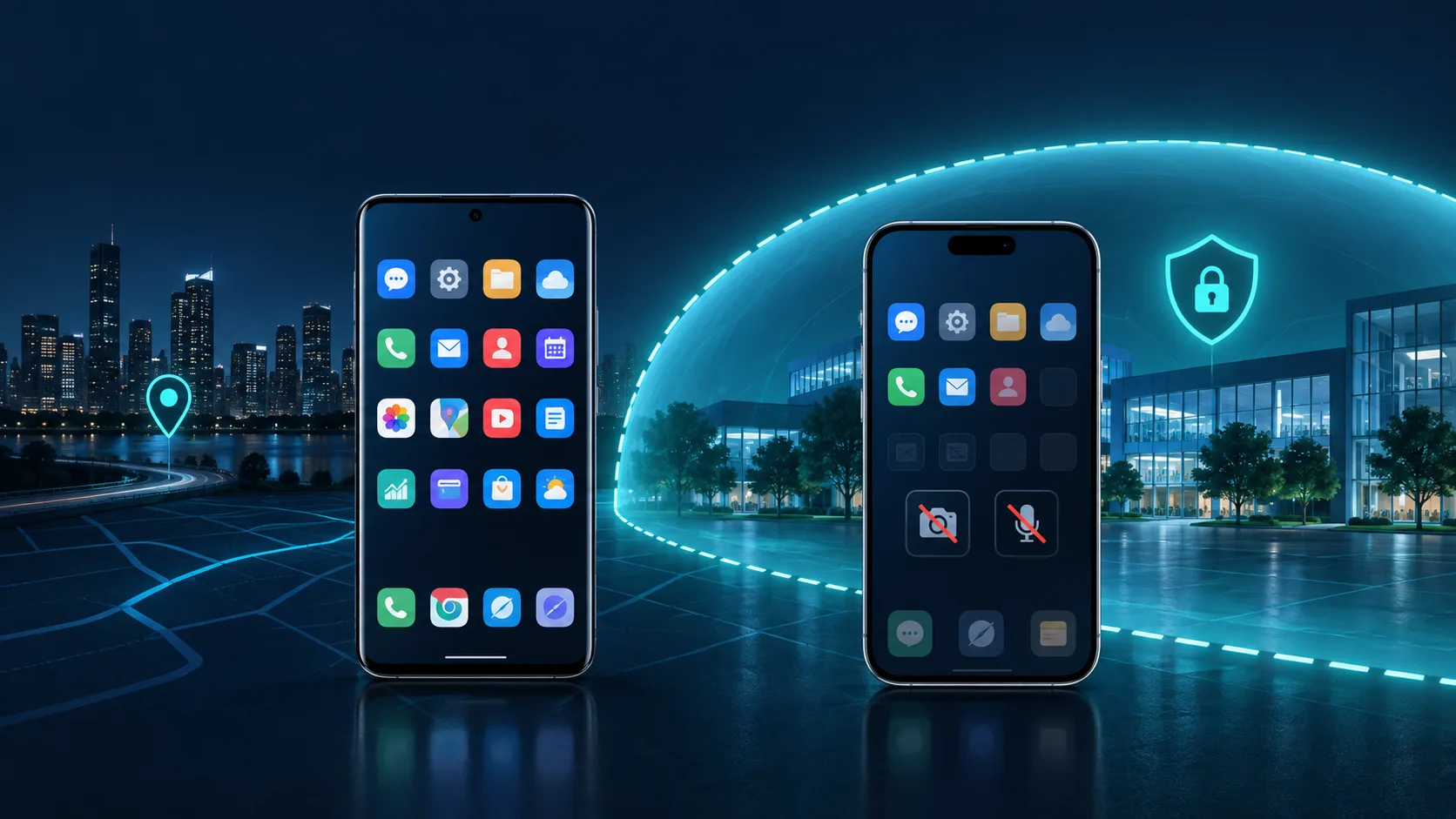
Niwaban continues my location-aware Android work: change which apps are available on a phone screen as a device enters or leaves a geofence. The modern project brings that idea to authorised, managed phone-and-watch deployments, with app access and supported camera, microphone and device policies tied to real places.
The public walkthroughs demonstrate a boardroom boundary, microphone policy and phone-to-watch app checks. They illustrate the experience; supported controls are configured and verified on the enrolled devices and management platform used for each deployment.
Earlier chapter: Stealth for Mobile and the original location-aware work →
Meyas Fashion
A personal collection becoming a living portfolio.
Meyas Fashion brings together Meah’s Filipina style, travel stories, editorial looks and music. My part connects her photo collection and portfolio to local AI production, with particular attention to preserving likeness across images and moving footage.
The engineering story follows the collection from source files to a traceable catalogue, controlled experiments and reviewed results.
MiniMax H3
Sunday Builders Club Spaces, made into short video summaries.
I use my MiniMax H3 workflow to make video summaries of Sunday Builders Club Spaces. It connects the ideas from a conversation with scene direction, reference material and locally generated clips.
Pinokio and ComfyUI provide the production route: the M3 handles the interface and queue, while two GX10 workers render the footage. I keep references, prompts and job records with the outputs so each take can be traced and reviewed.
ModelMule
What should I run on this machine, for this job?
ModelMule is my independent local-AI community and tooling project, helping people find, understand and run models on their own hardware. It brings IRC and newsgroup roots to practical model discovery and shared experience.
The testing work starts with a task and a real machine, then works towards model, quantisation and runtime choices supported by measurements, known limits and repeatable loading notes.
Bruce Castle Fieldwalk
From photographs to a walkable 3D environment.
Bruce turns a small set of iPhone photographs and twelve detail references into a walkable 3D environment. The photographs guide a Blender reconstruction of Bruce Castle, exported for exploration on the web.
Compare the model with the original views, walk through the environment, follow a narrated presentation or explore in VR on a compatible device. Geometry is approximate, and unseen structures are identified as inferred.
UK planning data
Public records connected into useful evidence.
I’m automating planning intelligence across UK public data sources: bringing fragmented planning portals, registers and spatial layers together for site history, constraints, precedents and decision support.
The work combines collection, searchable records and map-based exploration. UK-wide public-source coverage is the goal; coverage and document completeness are still being reconciled, so individual sources and gaps remain visible.
ESP32 & Diode
Small devices, two-way control, access through CGNAT.
My embedded projects connect ESP32 sensors and controls to browser interfaces. I’m adapting WebSocket patterns for two-way messages and exploring access through CGNAT using Diode’s blockchain-authenticated networking.
The device, local gateway and remote browser have different jobs. The ESP32 handles sensing and outputs; a gateway can publish a local service through an outbound Diode route. This does not require describing the microcontroller as a full blockchain node.
Try the weather lab to change simulated conditions, send device commands and compare public-cloud and private-cloud routes.
Starting point: Random Nerd Tutorials’ ESP32 WebSocket server. My CGNAT follow-up distinguishes local port forwarding from a tunnel to a hosted node.
My weather station
A sensor outside. A private cloud behind the readings.
In April 2024 I documented a BME280 weather station with a Raspberry Pi hosting the PHP service and database. ESP32/ESP8266 readings travel to the service, and the weather page presents the stored observations.
My Diode post connects that build to a private cloud behind a broadband connection without a public IP, with a gateway publishing the web view. The original weather path uses HTTP posts; the new simulation adds a separate WebSocket-style control channel to show how interactive device commands could fit.
Tutorial reference: Rui and Sara Santos, Random Nerd Tutorials — cloud weather station. The lab uses simulated readings; it is not a live feed from the station.